
Manufactured Homes
Mobile Home AC Repair in Parker County: Ducts, Package Units and Sizing for Manufactured Homes
By Geaux 72 Air & HeatUpdated 6 min read
The short answer
Most manufactured-home cooling problems in Parker County come down to three things: the equipment type (a package unit or a split system with a downflow air handler), the ducts in the belly under the floor, and sizing. Torn belly board and a crushed crossover duct cause more hot rooms than the AC itself does.
How manufactured homes are heated and cooled
Homes built to the federal HUD code, which covers manufactured homes built since mid-1976, put the ducts in the floor. A main trunk runs lengthwise inside the floor cavity, wrapped in insulation and held up by the bottom board, often called the belly board, with registers in the floor. A double-wide has a trunk in each half, joined by a crossover duct under the home.
The equipment feeding those ducts comes in two main forms, and which one you have shapes every decision, from a mobile home AC repair to a full replacement.
Package units
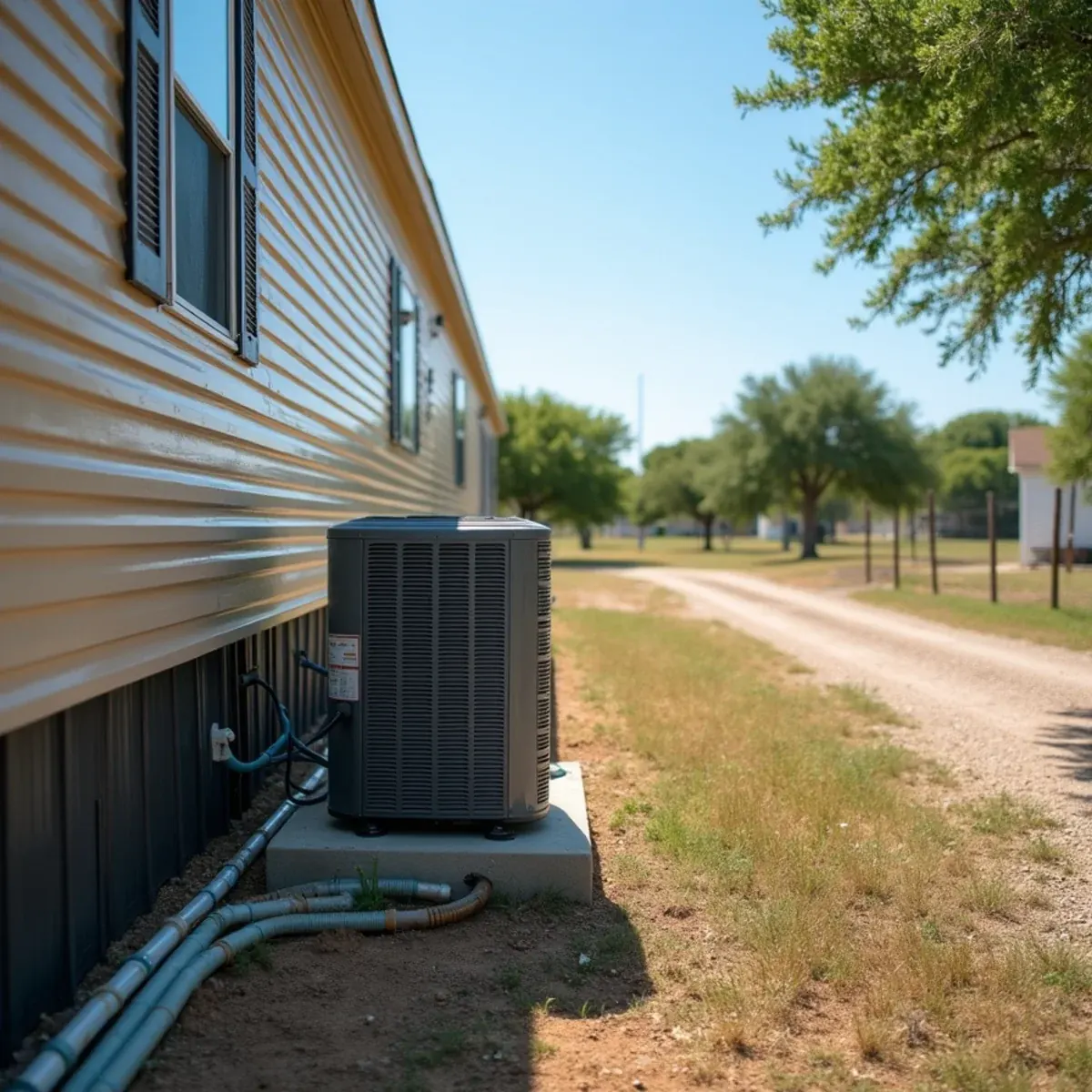
A package unit puts everything in one cabinet on an outdoor pad: compressor, coils, blower and heat source. Two short insulated ducts, supply and return, run through the skirting into the belly. Heat comes from a gas or propane burner (a gas pack), a heat pump or heat strips. The weak points are the connector ducts and airflow around the cabinet.
Split systems with downflow furnaces or air handlers
The other setup is a downflow furnace or air handler in an interior closet, blowing straight down into the floor trunk, with a condenser outside. Many older homes started with an electric furnace and had an AC coil added later. Under HUD-code rules, equipment installed inside the home must be listed for manufactured-home use, and gas or propane furnaces are sealed-combustion units drawing air from outside. A standard site-built furnace is not a legal swap.
| Feature | Package unit | Split system with downflow unit |
|---|---|---|
| Where it sits | All outdoors on a pad | Furnace or air handler in a closet; condenser outside |
| Duct connection | Two flex connectors through the skirting | Straight down into the floor trunk |
| Heat options | Gas pack, heat pump or heat strips | Electric furnace, listed gas or propane furnace, heat pump air handler |
| Common trouble spots | Crushed connectors, blocked airflow, rodents in the ducts | Undersized closet return, cramped coil, drain pan |
| Replacement notes | Level pad, connector ducts renewed | Indoor unit must be listed for manufactured homes |
Belly ducts, crossovers and rodent damage
The belly board is a thin fabric or plastic sheet, and in Parker County it takes a beating. Dogs and raccoons tear it, wind pulls it loose, and mice and rats nest in the insulation above it. Once it sags, ducts separate from their floor boots and cool air pours into the crawl space. The flex crossover on a double-wide gets crushed, chewed or left lying in the dirt. Our air duct repair service handles belly duct and crossover repairs, not just attic ductwork.
- One half of a double-wide is consistently warmer than the other
- Weak airflow at floor registers farthest from the unit
- Belly board visibly sagging or torn behind the skirting
- A musty or animal smell from the registers when the system starts
Do not crawl under the home or open the belly board yourself. Crawl spaces here hold snakes, fire ants, black widows and old wiring. Photos from outside the skirting are enough to plan the visit.
Sizing an AC for a manufactured home
A Manual J load calculation still applies. Insulation, window area, shade and which way the long wall faces all change the load, and older homes built before HUD thermal standards were tightened in the 1990s are far leakier than newer ones. A rule-of-thumb guess usually ends up oversized, and an oversized unit short-cycles and leaves the air damp.
Duct capacity matters just as much. A bigger unit cannot push more air through the same belly trunk; it just raises static pressure and noise. The technician should check both before recommending tonnage.
Package unit placement, skirting and airflow
A package unit needs room to breathe. Lattice, shrubs, lumber and hay bales against the cabinet starve the condenser coil, so keep about 2 feet clear on every side. A settled pad tips the unit and water pools in the drain pan. Connector ducts should be short, insulated, off the ground and sealed where they pass through the skirting so rodents cannot follow them in.
- 1Check the filter, often behind a return grille in a hallway or on the furnace closet door, or at the package unit itself.
- 2Turn the unit off at the outdoor disconnect, then clear grass, leaves and stored items from around it.
- 3Look at the connector ducts you can see from outside the skirting for crushing, tears or gaps.
- 4Confirm the thermostat is set to Cool and replace its batteries if the display is weak.
Replacing equipment on Parker County acreage
Replacement follows the same matched-system rules as any home, and new split systems now use R-454B or R-32 refrigerant. Inside a manufactured home, the indoor unit also has to be listed for that use. Permit rules differ between city limits and unincorporated Parker County; the contractor confirms which applies. Our page on AC installation and replacement covers sizing, SEER2 ratings and installation day.
Around Springtown, off FM 51 and out toward Reno, many manufactured homes sit on acreage beyond the gas mains, often on Tri-County Electric Cooperative lines, choosing between propane furnaces, heat pumps and electric strips. Our page on HVAC service in Springtown covers what we see on those properties.
What else keeps a manufactured home cool in a Texas summer?
A manufactured home has a thin roof, a lot of window glass for its size and a floor that loses cooled air through any gap in the belly. Equipment can only do so much against that, so the cheapest comfort often comes from the shell:
- A reflective roof coating on a metal or low-slope roof cuts the heat soaking into the ceiling on a July afternoon. It is usually the single biggest non-HVAC fix.
- Sealed and insulated belly board. Patching tears and replacing missing insulation under the floor keeps cool air in and keeps ducts from sweating.
- The marriage line on a double-wide. The seam where the two halves meet can open up over the years, letting attic and crawl-space air in. Resealing it helps both comfort and the crossover duct.
- Shade on the west and south windows: reflective film, exterior shades or blackout curtains during the hottest hours.
- Skirting with vents that let the space under the home breathe without letting animals in, especially near a package unit.
For an addition, a shop or one hot bedroom, a ductless mini-split is often the cleanest way to add cooling without touching the belly ducts, and it heats in winter too.
The bottom line for manufactured homes in Parker County
Before anyone sells you a bigger unit, have the ducts checked: the crossover, the belly and the supply boots. Then make sure any replacement indoor unit is listed for manufactured homes and sized with a load calculation, not by the tonnage on the old label. On acreage around Springtown and the rest of Parker County, that order of work fixes more hot rooms than new equipment alone. Start with air duct repair or AC installation and replacement, or call (321) 478-0693.
From the job site
Start under the floor, not at the condenser
On a typical weak-cooling call at a double-wide near Springtown, the condenser checks out fine: good pressures, good amp draw, a healthy split. The problem is under the house. The crossover is flattened under a joist, chewed open or lying in a puddle, and much of the cool air never reaches the second half. Fixing it often does more than any AC part.
The other recurring find is an original 1980s or 1990s electric furnace with a coil added later, squeezed into a cabinet never meant for it. Replace only the outdoor unit there and you get a mismatched system with the same airflow problems. The usual answer is a listed air handler or furnace with a matched coil.
- Note which side of a double-wide runs warmer.
- Take a few photos of the skirting and the area around the outdoor unit.
- Find the label on the indoor unit; it shows whether it is listed for manufactured homes.
Related questions
Can I put a regular furnace in a manufactured home?
What size AC does a double-wide need?
Why is one side of my double-wide hotter than the other?
Do you work on mobile home package units in Parker County?
Is a mini-split a good option for a mobile home?
Written by the Geaux 72 Air & Heat team for homeowners in Azle and nearby communities. General information, not a diagnosis or engineering advice: leave refrigerant, electrical and gas work to a licensed HVAC technician, who has the final word on your system. Every HVAC contractor we send is licensed and insured in Texas. Last reviewed October 2026.